 PLCU India
Holding a crypto asset, operating a service, making a payment and owing tax are different legal questions. PLCU should not be described as Indian legal tender or government-approved merely because it can be traded somewhere or taxed. The relevant answer depends on the activity and applicable rules.
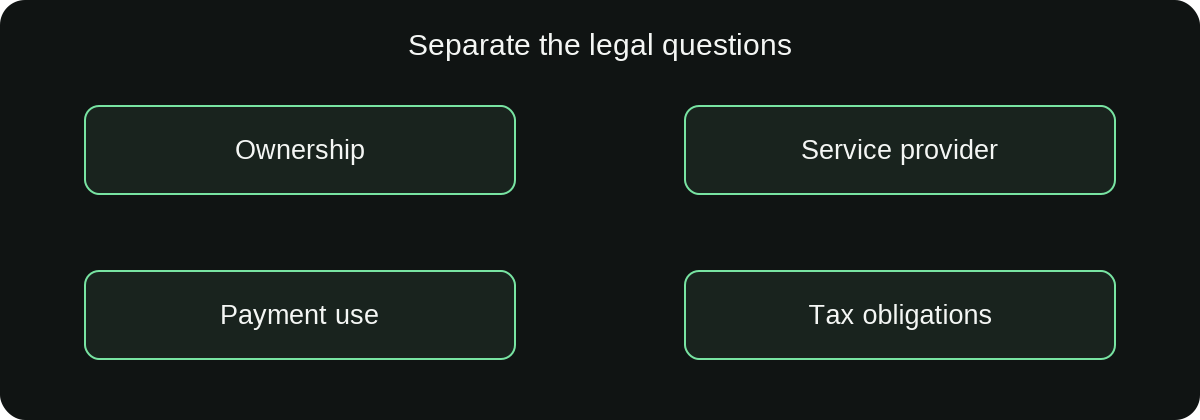
Avoid the misleading yes-or-no shortcut
A beginner asking whether a coin is legal may mean whether ownership is prohibited, whether a service can sell it, whether a bank will process a payment or whether a merchant must accept it. Those questions cannot be answered with one badge or a general claim that “crypto is regulated”.
For a specific transaction, identify the parties, location, service, asset and payment route. Cross-border arrangements and commercial products can raise issues beyond ordinary ownership. Do not assume a foreign provider's contract resolves Indian requirements.
This guide provides a framework for checking those questions. It does not issue a legal opinion for a particular PLCU investment product or establish that any named service has every permission required for your circumstances.
PLCU is not the digital rupee
The RBI's Digital Rupee FAQ updated in October 2026 describes e₹ as India's central bank digital currency and legal tender. It distinguishes a digital rupee from UPI, which is a means of payment. PLCU is not that RBI-issued currency.
A private coin being transferred electronically does not give it the same legal status as e₹. Nor does a merchant's willingness to accept it create an obligation for other merchants or public authorities to do so.
If a promoter uses “digital money”, “official wallet” or “global currency” language, ask which legal status they are actually claiming. Product terminology cannot substitute for a law, notification or permission that applies to the proposed activity.
The old RBI banking circular needs its historical context
In its 31 May 2021 clarification, RBI explained that the April 2018 circular had been set aside by the Supreme Court and could not be cited as valid on that basis. The clarification also discussed continuing due-diligence and related compliance requirements.
This historical point prevents a common error: quoting the 2018 circular as if it alone settles current ownership questions. It does not establish that banks must facilitate every crypto transaction, that every service is authorised or that all later rules can be ignored.
For a present transaction, check current bank and platform conditions as well as applicable law. If a restriction appears, ask for its actual basis through official channels rather than relying on an old screenshot circulated in a group.
What FIU registration means for a service provider
FIU-IND publishes AML and CFT guidance for VDA service providers, updated in January 2026. The framework concerns reporting entities and anti-money-laundering obligations. It is not a token-by-token investment endorsement.
When a platform claims registration, identify the entity and check the relevant official information. Do not transfer that claim to a separate app, distributor or coin without evidence. A brand can operate different services under different entities and terms.
Registration also does not promise that losses are insured, every payment channel is available or a particular asset's withdrawals will remain open. The Binance listing guide illustrates why service compliance and coin availability need separate checks.
Can you pay a merchant with PLCU?
Do not assume that technical ability to send coins makes every proposed payment appropriate. Confirm the merchant's identity, the agreement, how the price is determined and how refunds or disputes would be handled. Tax and recordkeeping questions may arise even when no INR sale occurs first.
| Question | Why you need an answer |
|---|---|
| Who accepts the payment? | Establishes the actual counterparty |
| What is being purchased? | Separates goods from an investment or paid product |
| How is the INR value documented? | Supports invoices and later reporting |
| What happens if delivery fails? | Clarifies contractual remedies |
| Is there a cross-border element? | May introduce additional obligations |
For routine Indian payments, do not portray PLCU as interchangeable with a bank transfer or UPI. UPI is a payment infrastructure, not evidence that a crypto asset is approved for all commercial purposes. A QR code alone cannot resolve the legal and contractual questions.
Taxation does not approve the underlying activity
A tax rule can apply to a transaction without endorsing the asset, service or sales method. The existence of a VDA tax regime therefore does not prove that a specific reward scheme is lawful or suitable.
The reverse inference is also unsafe: uncertainty about a provider's status does not make received income automatically exempt from reporting. Keep records and obtain advice on the transaction's substance. The PLCU tax guide addresses the 2026 statutory transition and the information needed for review.
Avoid a promoter's claim that a foreign account or self-custody wallet removes Indian obligations. Your residence and the activity can matter independently of where an app is registered. Do not conceal ownership, use borrowed identities or structure payments to avoid scrutiny.
Prepare the right questions for professional advice
Provide the exact product agreement, asset identity, payment route, countries involved and planned activity. Ask separately about ownership, service-provider status, payment use, tax and any cross-border requirements. A general question about “crypto legality” invites an answer too broad to guide a real transaction.
If the product involves promised returns, paid capacities or referral compensation, include those details. Omitting them can make advice about a simple coin purchase irrelevant to the arrangement you are actually considering.
Keep a dated record of the conclusion and the documents it relies on. Rules and service conditions can change. Revisit advice when the activity changes rather than treating a one-time answer as permanent permission for every related product.
Frequently asked questions
Does an Indian-language website prove the operator is authorised in India?
No. Language and local marketing do not establish the legal identity or permissions of the service provider. Identify the actual entity and activity rather than relying on localisation as a compliance signal.
Can advice about buying coins cover a later role as a paid promoter?
Not automatically. Distributing a product or receiving referral compensation changes the facts being assessed. Provide the new role and agreement when seeking advice instead of extending an earlier answer silently.
Should I describe a foreign registration certificate as an RBI approval?
No. State the issuing body, entity and scope accurately. A certificate from one registry cannot be relabelled as permission from a different regulator to make the offer sound more reassuring.