 PLCU India
PLCU transactions can fall within India's virtual digital asset tax rules. Separate tax on transfer income from TDS, and identify the applicable period before using an old section number or filing form. Receiving INR in your bank is not the only event that needs a record.
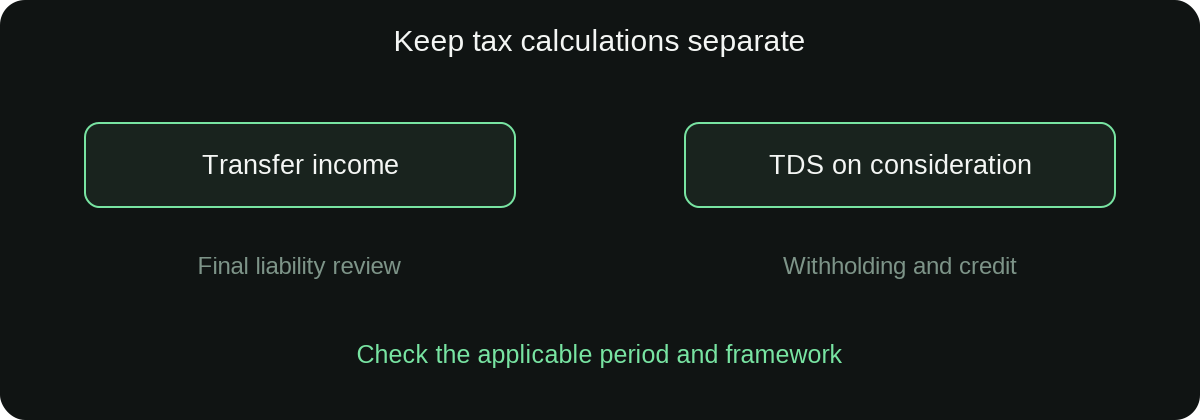
Start with the transaction date and applicable framework
Indian crypto guides often cite sections 115BBH and 194S of the Income-tax Act, 1961. Those references remain relevant to periods governed by that Act, but a guide reviewed in November 2026 must also account for the transition to the Income-tax Act, 2025.
The Income Tax Department's TDS transition FAQ says the earlier credit-or-payment event determines which Act applies: up to 31 March 2026 under the old Act, and from 1 April 2026 under the new Act. Section references and prescribed forms therefore need checking for the relevant period.
Do not copy a tutorial solely because it has “2026” in its title. Identify the tax year, transaction type, residency and filing context. A retrospective return and a current-year transaction can require different references even when the broad economic activity is similar.
The headline rates need their conditions
The Income-tax Act, 2025, as amended by Finance Act, 2026 provides a 30% rate for income from transfer of a VDA, with restricted deductions and loss treatment. This is not a general 30% charge on the entire amount of every withdrawal; applicable surcharge and cess also need consideration.
The same Act's resident-payment TDS provisions include a 1% VDA consideration rate, subject to applicable conditions and exceptions. The no-deduction threshold is ₹50,000 for qualifying individual/HUF payers and ₹10,000 for other payers. Eligibility and aggregation matter; these are not income-tax exemption limits for gains.
TDS is withholding, not automatically the final tax bill. Record deductions and reconcile eligible credit with the return. Do not assume that an exchange deducting something means every reporting obligation has been completed for you.
Use a gain calculation without pretending every cost is deductible
At a basic level, transfer income analysis starts with consideration and the allowable acquisition cost under the applicable rules. Keep trading fees, network fees, product fees and acquisition cost as separate fields until their treatment is assessed. Do not automatically subtract every cash expense in a tax computation.
As an arithmetic illustration, if consideration is ₹15,000 and an allowable acquisition cost is ₹10,000, the difference is ₹5,000 before applying the relevant tax calculation. These are hypothetical inputs, not PLCU prices or personalised tax advice. The example does not determine whether a particular expense qualifies.
Similarly, a loss on one transaction should not casually be netted against every other gain. The VDA regime restricts loss relief. Have the actual transaction set reviewed rather than using a portfolio's overall profit-and-loss display as the tax base.
Crypto swaps and reward products need separate classification
Exchanging PLCU for USDT is not merely moving between two screens. It can involve a disposal requiring valuation and reporting even before a later INR conversion. Keep both sides of the trade and their timestamps.
Farm or Minter arrangements introduce additional questions: what was purchased, when rewards were credited, when rights became unconditional and what was actually received. Do not assume every reward has the same tax timing as a purchased coin or that a locked dashboard entry is already a completed transfer.
The reward-mechanics article identifies the commercial inputs to preserve. A tax professional needs those facts; a label such as “passive income” is not a sufficient classification.
Build a transaction ledger with linked evidence
| Ledger item | Evidence to retain |
|---|---|
| Acquisition | Order fills, amount paid and source of funds |
| Wallet movement | Chain, transaction ID and both controlled addresses where relevant |
| Disposal | Quantity, consideration, timestamp and trading record |
| INR conversion | Payment reference and bank credit |
| TDS | Deduction record, reporting details and available tax credit |
| Rewards or migration | Applicable agreement and actual distribution evidence |
Separate transfers between your own wallets from purchases and sales, while retaining proof that both sides are yours. This prevents a data-import tool from misclassifying every outgoing transaction as a sale or every incoming transaction as new income.
Do not edit the only original export to force a reconciliation. Preserve raw files and maintain a separate working ledger. Record the valuation source and method so that an adviser can reproduce your numbers.
Match filing forms to the period
The department's transition guidance explains that older challan-cum-TDS forms apply to the corresponding earlier events, while the new framework uses revised prescribed forms, including Form 141 for the stated category of challan-cum-TDS statements. Do not assume the old Form 26QE instructions apply unchanged to a later event.
For returns, use the form, schedule and utility prescribed for the relevant year and your circumstances. The department's ITR-2 guidance discusses Schedule VDA in its applicable context. It should not be used to conclude that every individual, business or reward recipient must file the same return.
Also distinguish a reporting obligation from an automatically available platform export. A service may not provide every detail needed for Indian filing. Identify missing information early instead of waiting until the deadline.
Questions to take to a qualified Indian tax professional
Provide your residence status, transaction dates, product agreements and ledger. Ask about acquisition cost, reward timing, migration treatment, in-kind consideration, withholding responsibility and the applicable return. Include transactions where no bank withdrawal occurred.
If records are incomplete, explain the gap and the reconstruction method rather than inventing purchase prices. If a prior filing used an incorrect reference, obtain advice on the appropriate correction process. Do not rely on a promoter who offers to “pay all taxes” through a private crypto address.
Keeping the correct records is useful even when the final classification needs professional judgement. It allows the advice to address your actual activity instead of an idealised example that omits the difficult transactions.
Frequently asked questions
Can I choose a convenient cost figure when old records are missing?
Do not invent an acquisition cost. Preserve the gap, reconstruct evidence where possible and have the proposed method reviewed. A reasonable-looking number is not a substitute for a supportable record.
What if two imported files contain the same trade?
Deduplicate using stable references, timestamps, quantities and venue information while keeping the originals. Otherwise a ledger can count both consideration and withholding twice even though only one transaction occurred.
Can a tax payment prove a PLCU product is government-approved?
No. Tax compliance does not establish regulatory endorsement, product safety or investment suitability. Preserve the payment evidence for its tax purpose without presenting it as a certificate for the underlying product.