 PLCU India
Buy PLCU only after verifying a supported market for the exact coin and a usable withdrawal route. Buying USDT first does not establish either of those conditions. If the PLCU market or destination cannot be confirmed, stop before committing money to the route.
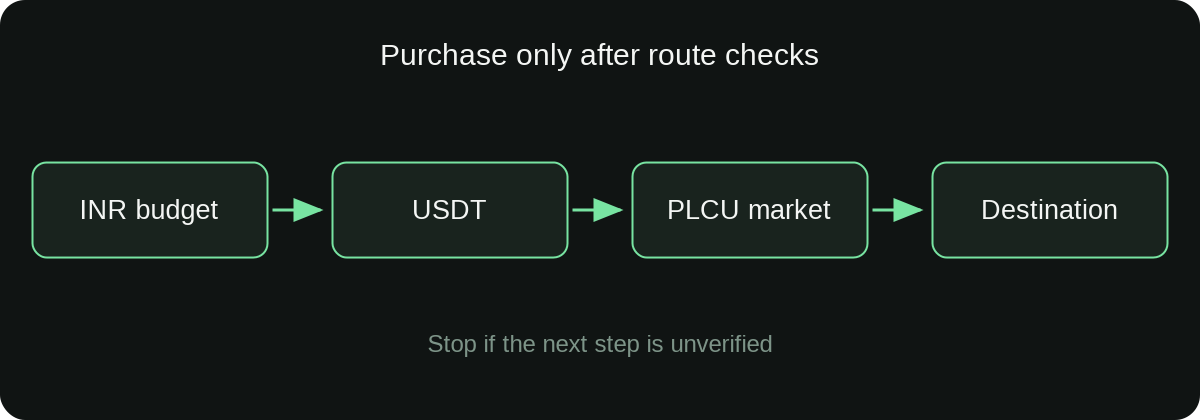
Work backwards from the asset you want to receive
Begin with the final destination. Identify the coin, its network and a wallet or account that explicitly supports it. Then identify a venue where an eligible Indian user can acquire that asset and withdraw it to the destination. This reverses the common mistake of funding an account first and researching compatibility afterwards.
The steps below are conditional: they explain how to evaluate and carry out a supported route, not certify that a particular PLCU market is available today. Historical listings are recorded in the exchange guide. Recheck the current screens and terms rather than treating those announcements as active offers.
Step 1: establish the purchase budget in rupees
Set a maximum total cost that includes funding, conversion, trading and withdrawal. Keep money needed for bills, debt payments and emergencies outside the experiment. If a route requires multiple transactions, do not spend the entire budget on the first asset and leave no allowance for later costs.
An indicative cost worksheet might include INR paid, USDT acquired, USDT transferred, USDT spent on PLCU and PLCU received after withdrawal. Use actual quotes at each point. Do not assume USDT always converts at a fixed rupee rate or that a platform's displayed dollar value represents an available bank conversion.
The useful unit is total INR per coin delivered, not the lowest advertised trading fee. A route can appear cheaper while delivering fewer coins after transfer costs and market impact.
Step 2: obtain USDT through an eligible method
Choose a service and payment method actually offered to your verified account. If considering P2P, read the order conditions before paying and keep the transaction within the platform's process. UPI appearing in a search article does not establish that it is available for your order.
NPCI's UPI FAQ explains the payment system and the importance of protecting the UPI PIN. Your PIN is not information to give a crypto seller or a supposed account-verification agent. Use your own permitted payment account and retain the transaction reference.
The Binance P2P preparation guide examines that funding task separately. Even a completed USDT purchase does not verify the next PLCU trade; it merely produces the first asset in a possible route.
Step 3: match the USDT transfer network
USDT on different networks cannot be selected solely by whichever fee looks lowest. Confirm that the sending platform and receiving venue support the same network and that the recipient's deposit instructions are current. A similar-looking address is not enough.
Binance's withdrawal guidance stresses matching the receiving address and network. This is a general transfer principle, not evidence that Binance supports PLCU deposits or withdrawals. Do not send PLCU into a USDT address.
Where appropriate, send a limited test that exceeds the receiving minimum and wait for credit. Record the transaction ID. If the test is not credited, investigate before sending the rest. A successful test validates that transfer under those conditions; it does not guarantee every later step.
Step 4: inspect the PLCU order before placing it
Use the exact spot pair and confirm that the ticker refers to the intended asset. Examine recent trades, bid–ask spread and the depth required for your quantity. Do not substitute a chart's last price for an executable purchase estimate.
| Item to review | Why it matters |
|---|---|
| Pair and asset version | Prevents buying a similarly named coin |
| Order quantity | Determines the depth and minimum requirements |
| Price limit | Defines the worst price you authorise for a limit order |
| Trading fee | Changes the net amount received |
| Withdrawal conditions | Establishes whether the planned destination is reachable |
A limit order constrains your accepted price but may not fill. A market order seeks available execution and may cross several price levels. Neither order type removes the underlying risk of holding the asset. Avoid repeatedly raising your price merely because a screen shows no immediate fill.
Step 5: reconcile the result before withdrawing
An order marked partially filled is not the same as receiving the entire intended quantity. Check completed fills, fees, remaining open orders and available balance. Cancel an unwanted remainder deliberately rather than assuming the unfilled portion has disappeared.
Once the coin is available, recheck the receiving wallet and withdrawal network. Read the fee and net quantity before confirming. Follow the PLCU transfer guide for the destination checks; do not copy a withdrawal address from a promoter's tutorial.
Keep purchase evidence even if you transfer immediately into self-custody. Wallet movement does not erase the original acquisition record. Separate coins acquired, network costs and any later sale so that the investment and tax records remain intelligible.
Know when the purchase should end without a trade
Stop if the asset version is unresolved, the market has no usable depth, withdrawals are unavailable or the account is not eligible. Also stop if completing the route requires sending funds to a stranger outside the platform's documented process.
There is no obligation to rescue a flawed plan because you already acquired USDT. You can review the costs of unwinding the first step rather than move into a less verifiable asset. Treat funding and investment as separate decisions throughout.
Frequently asked questions
Can I buy a fraction of PLCU instead of one whole coin?
Check the market's quantity precision, minimum order and withdrawal minimum. Divisibility does not guarantee your intended small order is operationally possible after trading and transfer deductions.
What if the order form rounds my chosen quantity down?
Review the revised quantity and total before submission. Quantity-step rules can leave part of your USDT unspent; record the actual fill rather than the number you originally typed.
Should I place another order while the first order status is unclear?
Resolve the existing order through the verified order history first. A duplicate order can create more exposure than intended, especially when the interface has a delayed update or partial execution.