 PLCU India
Compare PLCU and Bitcoin by what you can verify, how you can transact and what risks you can manage. A higher potential reward, lower displayed unit price or familiar founder does not by itself make one a better choice. An alternative should solve a specific problem, not simply provide another ticker.
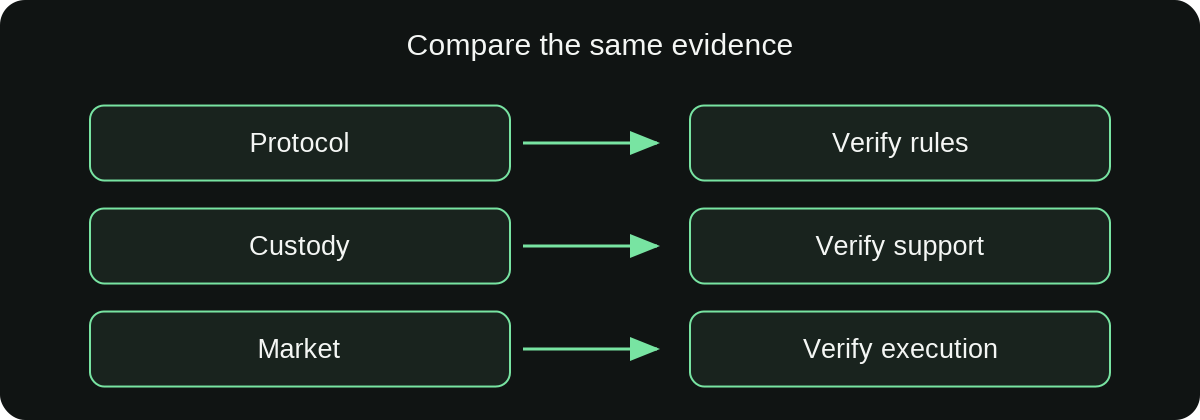
Choose the purpose of the comparison
A beginner learning self-custody, a trader seeking order-book access and a person considering a paid reward product have different needs. Start with the task. Otherwise a comparison can award one asset points for features that do not help the reader.
Write one sentence describing your objective: learning a transferable skill, making a payment, studying market structure or considering a speculative holding. Then define what successful access would look like. “More profitable” is not a workable criterion without a horizon, risk budget and evidence.
You do not have to choose either asset. Comparing them may show that your immediate goal can be achieved without financial exposure. Reading a wallet's documentation or analysing a public transaction does not require buying the coin.
Compare protocol claims on an equal basis
Bitcoin.org's FAQ describes Bitcoin's issuance limit and transaction mechanics. Those are starting points for understanding its protocol; they do not promise a rising market price. A documented supply rule is different from a valuation claim.
For PLCU, identify the version and the source date before comparing technology or supply. Do not lift historical specifications into a present-day comparison without checking their applicability. The PLCU identity guide explains why a consistent asset definition matters.
A fair comparison distinguishes a network's consensus, an application's functions and a paid commercial arrangement. A mobile product advertised as minting is not necessarily equivalent to running Bitcoin mining equipment or simply holding BTC.
The PLCU Core repository can help locate material for technical review. Its existence alone does not assign the project a security rating or establish that a downloaded app matches the source.
Use a task-based comparison table
| Criterion | What to examine for Bitcoin | What to examine for PLCU |
|---|---|---|
| Asset identity | Native BTC and any wrapped representation separately | PLCU version, chain and historical naming |
| Market access | Eligible venues, depth and withdrawal conditions | Verified current markets for the exact coin |
| Custody | Wallet signing and recovery support | Explicit support for the relevant PLCU chain |
| Supply evidence | Protocol rules and chain data | Current definitions, migration and release evidence |
| Return claims | Price exposure versus separate lending or products | Coin ownership versus Farm or Minter arrangement |
| INR exit | Full route and applicable obligations | Same full-route test, without assumptions |
This is a research framework rather than a current numerical ranking. It deliberately avoids comparing one asset's measured properties with the other's marketing adjectives. Every row should be supported by evidence of the same kind.
Unit price is not affordability or value
A low per-coin price does not mean an asset is cheap, just as a high unit price does not mean you must buy an entire coin. Check divisibility and the venue's minimum order. Valuation depends on more than the price of one unit.
Supply, ownership rights, demand and liquidity all matter. Multiplying a small unit price by a very large supply can produce a substantial valuation, while an uncertain circulating figure can make the result unreliable. Do not select a coin because it appears easier to “reach” a round number.
For an Indian budget, compare the amount actually delivered after costs. Network fees, spreads and withdrawal minimums can make small experiments uneconomical. That is an operational issue distinct from whether the asset's price will rise.
Alternatives should match the problem you are trying to solve
If the goal is to understand programmable transactions, an Ethereum learning route may be relevant, provided you study its own wallet and fee model. If the goal is to understand stablecoin transfers, evaluate the issuer, chain and redemption risks rather than treating the token as risk-free cash.
If the goal is merely to learn order types, use educational material or an appropriate simulation before committing funds. A new speculative asset is not necessary to practise distinguishing a bid, ask and limit order.
If the goal is preserving essential rupee savings, a volatile coin comparison may be the wrong starting point altogether. Consider the nature of the need before seeking a crypto substitute. No category automatically fits every reader.
Compare total risk rather than a single feature
An asset can have good documentation but still experience severe price declines. A platform can offer convenient INR funding while introducing custody risk. A self-custody wallet can remove one intermediary while increasing your responsibility for backup and transaction accuracy.
Map the risks separately: market, liquidity, protocol, provider, device and compliance. Then identify which ones you can realistically manage. A score out of ten often conceals the fact that one unresolved issue can make the route unusable.
Do not assume two crypto holdings provide meaningful diversification merely because their logos differ. Shared trading venues, speculative demand or funding channels can create common exposures. Correlation also changes over time and should not be asserted without an appropriate dataset.
Make the decision reproducible
Save your criteria, sources and unresolved questions. If one asset wins only because you assigned a generous future price, separate that forecast from the factual comparison. Another reader should be able to see what is observation and what is assumption.
For PLCU, investigate liquidity and history before treating an old high as a future destination. For either asset, confirm the Indian legal and payment distinctions rather than equating overseas availability with local suitability.
A useful comparison ends with a reasoned next step: more research, a limited learning exercise, a suitable allocation or no purchase. It should not pressure the reader into selecting a winner just because the article presents two columns.
Frequently asked questions
Is a newer blockchain necessarily more secure than an older one?
No. Age alone does not establish security. Examine design, review, implementation and operational evidence, while keeping the security of your chosen wallet and service separate from protocol claims.
Can I compare annual returns from different date ranges?
Not meaningfully without aligning the periods and explaining the method. Selective dates can make a weak comparison look persuasive; retain the same start, end and currency basis where possible.
Does placing a coin on a shortlist mean it suits my portfolio?
No. A shortlist identifies assets for further study. A final decision still needs your budget, liquidity needs, access conditions and applicable obligations; the comparison table is not a personal allocation recommendation.