 PLCU India
Installing Ultima Farm does not establish free PLCU income, a fixed staking APR or ordinary phone-based mining. Identify the product, reward asset, paid requirements and release terms before treating any displayed reward as an investment return. Different ecosystem names can describe different arrangements.
What the app description actually says
The Ultima Farm App Store listing describes a farm-wallet application involving PLCU and PLCUX, selection of an ULTIMA MINTER and coin funding. Its text specifically discusses PLCUX minting. That is not sufficient to publish a current PLCU reward rate or claim that merely installing the app earns coins.
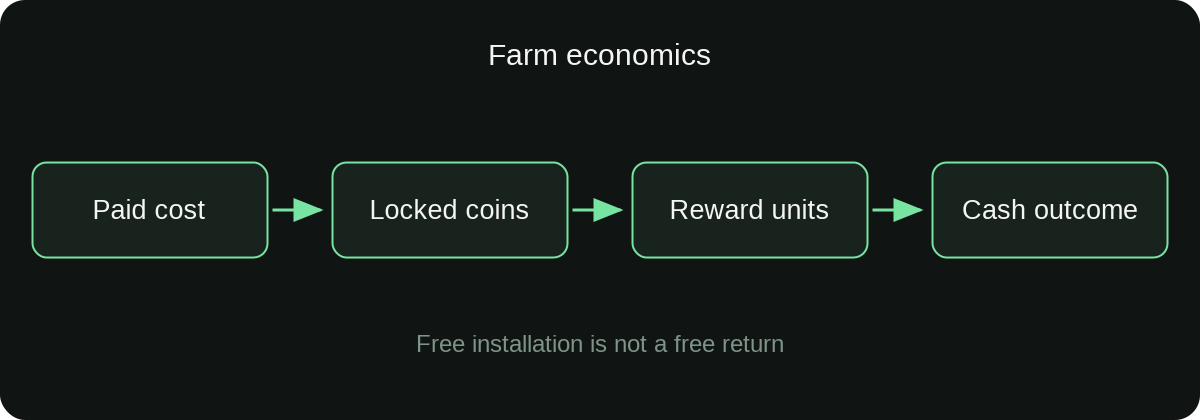
An app being free to download says nothing about the total cost of participating in a connected product. Separate software installation from paid certificates, subscriptions, coin purchases and locked balances. A tutorial that counts only the download cost does not answer whether the economic arrangement is free.
Before doing anything, identify the asset denomination in the actual product terms. PLCU, PLCUX and other ecosystem units cannot be substituted in a return calculation because their names appear on the same screen.
Mobile control is not the same as network mining
A phone can provide an interface for authorising a product arrangement without performing the network work usually associated with proof-of-work mining. Conversely, an asset lock called “minting” is not automatically proof-of-stake validator participation.
The project's historical whitepaper discusses a minting ecosystem. Its marketing terminology should not be used to promise that a current phone app performs profitable network mining. To understand a current offer, ask what operation creates the reward and which system enforces the obligation.
This distinction helps you compare products honestly. Buying a paid entitlement and locking coins has different risks from running independent hardware or delegating to a documented validator protocol. A shared word such as “mining” cannot establish identical mechanics.
Obtain the agreement behind the reward screen
Ask for the terms applicable to the specific product and purchase date. Identify the provider, upfront costs, required coin balance, duration, reward denomination, payout conditions and treatment of early exit. Do not rely on a salesperson's arithmetic without those inputs.
The project's general terms distinguish platform registration from separately contracted chargeable products or capacities. That distinction is relevant to cost analysis; it is not a determination that any current offer is authorised or suitable in India.
| Required information | Why it changes the result |
|---|---|
| Paid product cost | Money spent before any reward is received |
| Coins committed | Capital exposed during the arrangement |
| Release conditions | Whether rewards or principal are actually transferable |
| Reward asset | Which market price and exit route are relevant |
| Provider obligations | Who must perform and under which agreement |
| Early-exit terms | Whether your expected liquidity is realistic |
A missing answer is a reason to pause, not permission to assume the most favourable condition.
Calculate cash outcome instead of coin growth alone
Separate the number of additional coins from the value you can realise after costs. An increasing token balance can coexist with a negative INR outcome if the price falls, selling is difficult or paid product costs are substantial.
Use this framework: realised proceeds plus remaining conservatively valued assets, minus initial expenditure, later costs and applicable taxes. Do not assign a sale price to rewards that cannot yet be sold. Keep locked and freely transferable balances in different columns.
For a purely illustrative comparison, a product that credits 20% more units does not guarantee a 20% rupee gain. If the per-unit sale value falls, the larger quantity can still be worth less. No hypothetical percentage here is a PLCU APR or a prediction.
Why APR and APY labels need definitions
APR normally describes an annualised rate without compounding, while APY incorporates a compounding assumption. Neither label is meaningful without the measurement period, costs, reward denomination and conditions required to reinvest.
A product may display a schedule rather than a market-derived annual rate. Do not rebrand that schedule as staking APR unless the underlying mechanics support the comparison. Also avoid annualising a short promotional period without explaining why the rate would persist.
There is no verified current PLCU staking APR supplied in this article. For a specific offer, obtain a dated rate and methodology from the provider, then assess whether distributions are contractual, discretionary or linked to network activity.
Test the exit before believing the return
Ask where received units can be transferred and sold, which network is required and whether the claimed market has usable depth. A balance available inside a product is not necessarily external liquidity. A promoter buying a small amount privately does not establish a dependable market for larger withdrawals.
If participation depends on referrals, record referral compensation separately from the product's underlying economics. Payments for recruiting users are not evidence of external demand for the coin. Avoid presenting your own referral income as an ordinary return available to every holder.
Read the investment risk review before making a long lock-up decision. The relevant question is whether the arrangement fits your loss capacity and liquidity needs, not whether the reward dashboard looks impressive.
A decision you can make without paying
You can reject or defer an offer when its cost, asset or exit remains unclear. Paying first to unlock an explanation reverses sensible due diligence. You should be able to understand the agreement before accepting it.
Save the terms and advertising that influenced any existing purchase. Reconcile actual distributions with the schedule and maintain a record of unresolved differences. This supports a precise enquiry or complaint without making unsupported claims about the provider's intent.
Frequently asked questions
Does keeping my phone online increase the promised reward?
Do not assume so. Only the applicable product mechanics can establish whether device activity affects distributions. A counter that updates when the app opens is not itself evidence of extra network work.
Should reward projections include the cost of a replacement phone?
If a device or operating cost is genuinely necessary for the arrangement, keep it in the economic cost analysis. That does not automatically determine whether the expense is deductible for Indian tax purposes.
What if a salesperson quotes rewards in one coin but the agreement names another?
Stop the calculation and request clarification in writing. Do not choose the more favourable denomination; price, supply and exit assumptions must follow the actual asset specified in the agreement.