 PLCU India
Treat guaranteed returns, private recovery offers and unexplained unlock fees as reasons to stop and verify. Do not send signing secrets or additional money to someone claiming they can release PLCU. Identify the exact problem before labelling it or choosing a response.
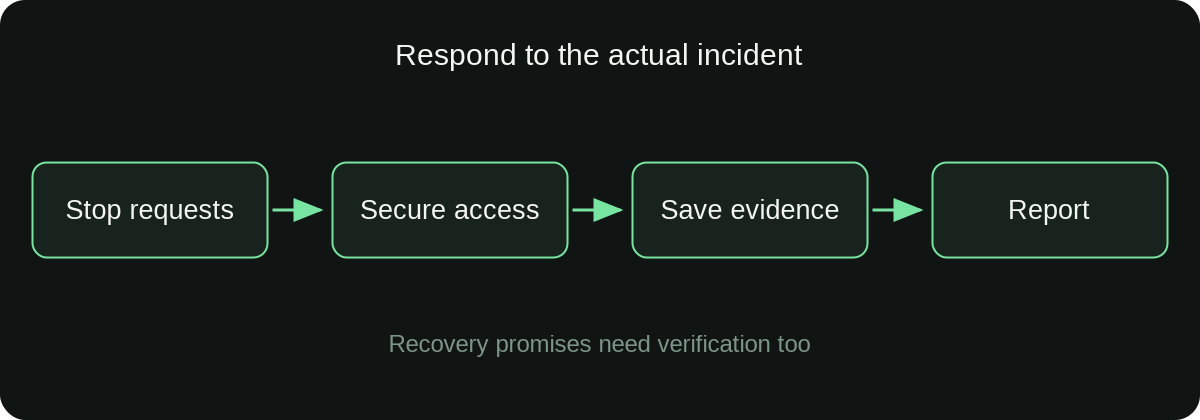
Distinguish an investment loss from evidence of deception
A falling price, thin market or delayed service is not by itself proof of criminal intent. Preserve the facts: what was promised, who made the statement, what you paid and what happened. Unsupported accusations can obscure the evidence that actually matters.
At the same time, you do not need to establish a crime before declining an unsafe request. If an offer requires secrets, unidentified payments or action outside documented procedures, you can stop while checking it. Verification should not depend on first transferring money.
The goal is a practical response to a specific situation. A fake support account, a compromised wallet and an unsuitable investment contract require different actions even when all are discussed in the same chat group.
Watch for a changing reason to pay
An initial “verification” charge followed by a “liquidity”, “tax” or “release” charge can be a warning pattern. Ask for the contractual or statutory basis, the recipient's identity and the official payment process. A message saying funds are frozen does not establish the charge.
Never assume a private wallet address is a legitimate Indian tax-payment channel. Tax obligations should be assessed through the applicable official process. A person threatening permanent loss unless you pay immediately may be exploiting urgency rather than explaining an obligation.
Retain each demand in sequence. The changing explanation can be more informative than any single screenshot. Do not delete the conversation simply because you have decided not to continue.
Fake migrations exploit genuine historical events
PLCU naming history gives impersonators plausible material. A message can cite a real old transition while directing you to an unrelated present address. The existence of a historical migration does not authenticate the sender or create a new deadline.
Confirm the current notice through a source independent of the incoming message. Identify the affected asset, eligible holders, conditions and receiving mechanism. Do not give an “administrator” your seed phrase to check whether you qualify.
The news verification guide explains how to preserve dates and distinguish old announcements from active instructions. A screenshot reposted by many accounts can still trace back to one unverified source.
Check account, device and wallet exposure separately
If you only opened a page, do not assume the same response as if you disclosed a seed. If you entered an exchange password, secure the account and its recovery channels. If you installed software, consider whether the device itself may be compromised before using it for further sensitive actions.
If signing credentials were disclosed, changing a website password does not remove the attacker's ability to sign from those credentials. Use verified wallet guidance and a clean environment to assess moving assets to a securely established wallet. Do not restore the same exposed seed and call it a new secure wallet.
If assets have already moved, preserve the transaction IDs and destinations. Blockchain evidence helps document events but does not give a support agent a universal reversal power. Avoid anyone promising guaranteed recovery in exchange for a fresh deposit.
Indian payment evidence needs its own protection
Save the UPI reference or bank UTR, amount, time, beneficiary details available to you and relevant account statements. Link them to the order or conversation. This is different from preserving a blockchain transaction ID; both may be needed to reconstruct the flow.
NPCI's fraud-awareness guidance warns that scanning a QR code and entering a UPI PIN is for making a payment, not receiving one. A supposed refund process that asks you to authorise a debit deserves immediate scrutiny.
Contact your bank or payment provider through its independently verified channel if an unauthorised or deceptive transfer is involved. Do not use the phone number supplied by the person demanding the payment.
Report financial cyber fraud through official channels
The government's cyber-fraud advisory directs users to report cyber fraud through the national portal or 1930. Prompt reporting can support an official response, but it is not a guarantee that assets will be recovered.
Prepare a factual chronology and retain the original material. Include the website, contact handles, payment references, transaction IDs and representations that led to the payment. Redact unrelated personal information when sharing outside the official complaint process.
Do not pay a person claiming to accelerate the report or bypass a police procedure. Verify every request through the actual authority. A case number repeated in a private message does not prove the sender works for that authority.
Avoid a second incident during recovery
People who publicly describe a loss may receive offers from “ethical hackers”, lawyers or recovery agents. Some may know transaction details because the chain is public. Knowing those details is not proof they can recover funds or represent a legitimate service.
Ask for verifiable identity, scope, fees and realistic limitations before considering professional help. Never grant remote device access or share signing secrets merely because someone offers a confident explanation. A useful adviser should be able to discuss the process without asking for control of your wallet.
If a group pressures you to buy another product to repair the first loss, evaluate it as a new financial decision. Sunk expenditure does not make the next proposal safer. Record the new claim and keep it separate from the original complaint.
Keep a concise incident file
Organise the timeline, financial records, public chain evidence and actions already taken. Note what is confirmed and what remains suspected. This reduces repeated explanations and helps banks, platforms or authorities address the relevant facts.
For ordinary access loss without evidence of theft, consult the wallet recovery article. An inaccessible device is not automatically a hack, and a fake recovery offer can turn a manageable access issue into an asset loss.
Frequently asked questions
Should I confront the suspected impersonator before preserving the messages?
Preserve evidence first and follow official guidance. Confrontation can lead to deleted material or additional pressure; factual records are more useful than an argument about the person's intentions.
How should I record a disappearing-message conversation?
Preserve relevant material promptly using lawful available tools, with contact details and timestamps. Retain the originals where possible and explain any missing parts rather than reconstructing quotations from memory.
Can I publish the suspect's identity documents to warn others?
Avoid distributing sensitive documents or unverified allegations. Provide relevant evidence through official reporting channels and keep any public warning limited to supportable facts and protective steps.