 PLCU India
PLCU supply figures are meaningful only when the asset version, measurement date and definition match. A historical maximum supply, a wallet balance and a contractual release schedule answer different questions. Do not combine them into one tokenomics table without reconciliation.
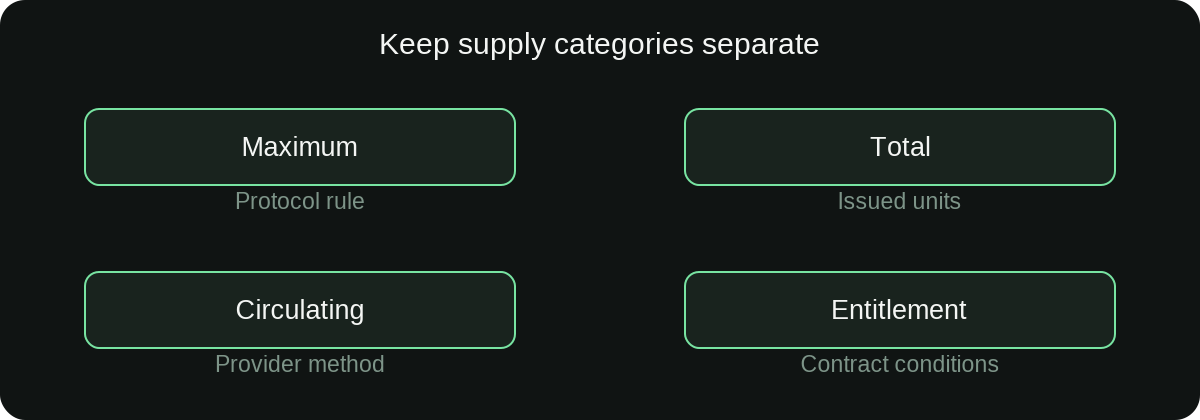
Define the number before copying it
Maximum supply describes a protocol limit under its stated rules. Total supply generally measures issued units subject to the provider's treatment of burns. Circulating supply estimates the portion considered available to the market. These categories need not be equal, and providers may use different inclusion policies.
The project's historical whitepaper contains a supply specification in a 2022 context. It is not sufficient evidence for today's post-migration circulating supply. Copying an old number next to a newly retrieved price can create a valuation that never existed on a consistent basis.
Start a source table with separate rows for each definition. Include the document or explorer, its date, the chain it describes and any exclusions. Where the method cannot be established, mark the figure unverified instead of averaging conflicting values.
Keep migration history in the supply analysis
MEXC's migration announcement documents the distinction between the original coin renamed PLCUC and a new PLCU chain. That makes ticker continuity an important issue when comparing old supply pages with newer ones.
A conversion between assets may affect each chain differently. A documented burn on one chain is not automatically a reduction in supply on another. Equally, an account displaying an entitlement to future units does not prove those units are presently circulating.
This is why a headline such as “only a few coins left” needs more than a promotional chart. Ask which asset, which supply category and which evidence support the statement. The answer should identify a measurement, not merely repeat a scarcity slogan.
An unlock schedule can describe different obligations
In crypto discussions, “unlock” may refer to vesting, a contractual distribution, the end of a product lock or the opening of withdrawals. Each has a different effect. A product allowing a user to withdraw already issued coins is not necessarily creating new supply.
The project's historical swap terms describe a PLCUC-to-PLCU arrangement with instalment distributions. Those terms are evidence about that arrangement, not a universal release calendar for all holders or a confirmation that the offer remains available.
To examine your own position, identify the agreement date, assets surrendered, units promised, release conditions and units already delivered. A dashboard is useful, but retain the underlying terms and transfer records as well. Do not send coins to a newly supplied address merely because an old agreement mentions a swap.
Build a reconciliation you can explain
A practical worksheet separates claims that can be checked on a chain from claims requiring contractual evidence.
| Item | Evidence to look for | Interpretation problem to avoid |
|---|---|---|
| Issued units | Chain data and documented method | Treating all wallet totals as circulating |
| Burned units | Verified mechanism and applicable chain | Assuming an inaccessible address proves a burn |
| Locked holdings | Terms, addresses and release conditions | Assuming locked means permanently removed |
| Future distribution | Applicable agreement and schedule | Counting a promise as a received balance |
| Circulation estimate | Provider methodology and timestamp | Treating an unexplained estimate as exact |
A reconciliation does not need to force every category into a single tidy total. Its value lies in showing what is established and where the definitions differ. If a number cannot be reproduced, keep its uncertainty visible.
Do not infer that every unit in a large address belongs to a single investor. Exchanges can aggregate customer balances, while one person can use many addresses. Holder concentration requires attribution as well as arithmetic.
Why an unlock does not predict a price drop by itself
A release can increase transferable units, but price impact also depends on recipients' behaviour and available buyers. Some recipients may hold; others may transfer between their own wallets. A transfer count does not reveal intent to sell.
The reverse claim is also weak: a small stated release does not prove low selling pressure if other holdings are already liquid. Consider the size of potential sales relative to verified market depth. A supply event and the order book describe different parts of the problem.
If you model a scenario, label the assumptions. For example, a spreadsheet can vary the share of released units offered for sale without claiming those sales will happen. The result is a sensitivity check, not original evidence about what holders intend to do.
When reviewing a burn claim, distinguish a protocol-enforced destruction mechanism from an address described as inaccessible. The evidential basis matters because a visual label is not a mathematical demonstration that units can never move. Keep the claim and the verification method together.
How to update your records without losing the past
Keep an original observation and append the next reading. Record whether a change reflects issuance, a revised definition, a migration or a corrected source. Simply overwriting yesterday's figure can make it impossible to explain an apparent jump.
For holdings subject to a product arrangement, link the distribution record to the corresponding transaction. Record rewards separately from purchased units and returned principal. This supports both investment review and later tax classification without assuming those categories receive identical treatment.
The Farm and Minter guide explains why a reward dashboard is not automatically an estimate of market-wide supply. Use the price guide only after the supply identity is settled; otherwise the resulting market capitalisation is unreliable.
Frequently asked questions
Does a vesting cliff necessarily release the entire allocation?
No. A cliff may be followed by instalments or other conditions. Read the actual schedule and allocation covered; the label alone does not determine how much becomes transferable at the first date.
How should I handle a schedule that states dates in UTC?
Keep the original timezone and record the corresponding Indian time separately. Do not silently reinterpret midnight in another timezone as midnight in India when setting reminders or comparing releases.
What if a release occurs later than the schedule I saved?
Retain the original terms, the expected date and actual delivery evidence. Ask for a specific explanation or revised notice; do not overwrite the original record and lose the basis for comparison.