 PLCU India
Do not call PLCU audited without a report identifying the auditor, scope, software version and findings. The CertiK profile retrieved for PLC Ultima states “Not Audited By CertiK”; a project profile is not an audit certificate. That observation does not establish that no other review has ever existed.
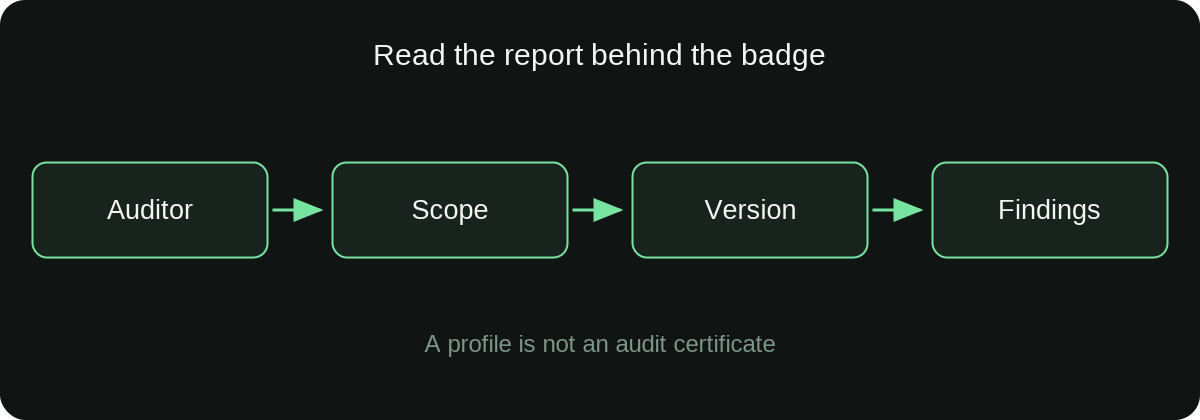
Distinguish a profile from a report
Security websites can display project pages containing scores, community activity, links and monitoring fields. These pages serve different purposes from a manual code audit. The presence of a familiar security-company logo does not tell you which service was performed.
The CertiK PLC Ultima profile is a primary source for what CertiK displays about its own coverage. Its audit-status field should be read directly. Do not convert a third-party profile into a claim that the coin, app or commercial product has passed a comprehensive review.
Equally, avoid treating a missing public report as proof of fraud or a specific exploitable vulnerability. The correct conclusion is narrower: the audit claim has not been established by the evidence provided. Financial and reputational allegations require their own evidence.
Ask which component was examined
A crypto ecosystem can include a blockchain client, a mobile wallet, websites, server infrastructure, smart contracts and paid products. Reviewing one component does not certify the others. The first question should therefore be “what was in scope?” rather than “did the brand get an audit?”
The PLC Ultima Core repository identifies software that can be inspected, but public code is not itself a review result. A report should identify the relevant version or commit and explain what the reviewer actually tested.
For an application, ask how the reviewed code relates to the binary distributed through the store. For a contract, identify the deployed address and network. For a protocol, examine whether later upgrades changed the assumptions. Scope is what connects a report to the product you intend to use.
Read findings before the marketing summary
An audit usually describes a limited assessment under stated conditions. Findings can have severity levels, remediation statuses and residual risks. A statement that issues were “resolved” needs context: were fixes inspected, and does the deployed system include them?
| Report field | Practical question |
|---|---|
| Auditor | Can the report be found through the reviewer's own channel? |
| Date | How old is the assessment relative to the current release? |
| Scope | Which files, contracts or applications were included? |
| Version | Does the inspected code match what users interact with? |
| Findings | Which issues were identified and how were they addressed? |
| Exclusions | What important components were not assessed? |
Do not judge the report by the number of pages or coloured badges. A long document with unclear scope may answer less than a short precise assessment. Conversely, a concise report is not automatically incomplete if the task is narrow and clearly defined.
Verify authenticity without exposing assets
Obtain the report from the auditor or a verifiable primary publication. Compare any project-hosted copy with that source. A screenshot saying “passed” is not a substitute for the actual report and its date.
You should not need to connect a funded wallet, sign a message or pay a release fee to read a public audit. If a site demands those actions, verify the source independently. Do not follow instructions embedded in an unfamiliar PDF to install a browser extension or run code.
If only a private assessment is claimed, ask what can be disclosed and how the auditor confirms the engagement. A confidentiality explanation does not justify presenting undisclosed findings as a public guarantee. Keep your conclusion proportional to what can be established.
An audit does not settle the investment decision
Code review cannot guarantee market liquidity, token value, provider solvency or bank access. It also does not protect a user who installs a counterfeit app or shares signing secrets. These risks require separate analysis.
A reward product may depend on a commercial agreement in addition to software. Even if a contract operates exactly as designed, the agreement's economics can be unsuitable. Read the Farm and Minter guide to separate mechanics from an assumed return.
Similarly, an audit is not an Indian regulatory approval. Do not combine a security badge with FIU registration language to imply that a government body endorses the coin. Each claim belongs to a different evidential and legal category.
Build a compact audit evidence record
Create one row per claimed review. Record the auditor, report URL, publication date, scope, version and current deployment evidence. Then add unresolved issues and exclusions. This avoids repeatedly counting the same engagement when it appears on multiple websites.
When the product changes, revisit the link between the report and the current release. A report can remain a valid historical assessment while no longer covering the version you intend to use. Do not delete that context by referring to it simply as “the latest audit”.
The useful output is a sentence you can defend: a specified reviewer assessed a specified component at a specified version, with stated findings. If those details are unavailable, describe the audit claim as unverified rather than inventing a security conclusion.
What to do when a promoter will not provide details
Request the report and scope through a recorded channel. Avoid arguing about a broad label such as “safe”; ask for the concrete evidence instead. If the response repeatedly substitutes testimonials or community size, the original audit question remains unanswered.
You can decline to fund the product while that gap persists. You do not need to prove wrongdoing before deciding that the evidence is insufficient for your own risk tolerance. This is a decision about the standard you require, not a public accusation.
Frequently asked questions
What does an accepted-risk label mean in an audit finding?
It usually indicates that an issue or design trade-off was acknowledged rather than removed. Read the report's own status definitions and rationale before treating it as a completed fix.
Is a clean automated scan equivalent to a manual audit?
No. Automated checks have a defined detection scope and can miss design, operational or contextual issues requiring other assessment methods. Identify the service actually performed before comparing its conclusions.
Can a bug-bounty programme replace a published audit report?
They provide different evidence. A bounty invites vulnerability reports under stated rules; an audit documents an assessment of a defined scope. Neither alone proves that all important risks were examined or eliminated.