 PLCU India
PLCU is unsuitable for money you cannot afford to lose or leave inaccessible. Before considering any allocation, resolve the asset identity, evidence for the product thesis, usable liquidity, custody and Indian compliance obligations. A promised coin reward is not enough to establish a good investment.
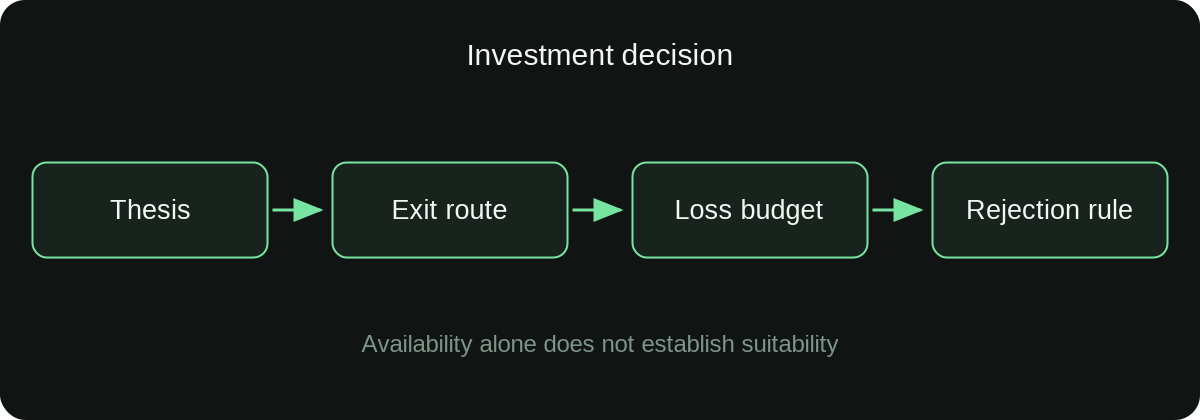
Separate the investment from the sales presentation
A presentation can combine a coin, a wallet, paid products and referral opportunities into one attractive story. Your financial exposure may be much narrower and riskier than that story suggests. Identify exactly what you would purchase and which rights you would receive.
If you are buying spot coins, ask what supports demand and how you could exit. If purchasing a product entitlement, examine the provider's obligations and the release conditions. If receiving referral compensation, analyse it separately from the underlying asset's return.
A decision based on “the community is growing” is incomplete unless you can connect the observation to a relevant, measurable benefit. More group members do not necessarily create deeper markets or improve your legal rights.
The project's general terms distinguish registration from separately contracted chargeable services. Read the specific agreement behind the offer rather than treating a platform account as the investment itself.
Question 1: can you identify what you will own?
Record the coin, chain and product agreement, if any. PLCU has a history that makes naming continuity important. If a seller cannot distinguish your intended asset from PLCUC or another ecosystem unit, do not treat their price or reward calculation as reliable.
Use the beginner identity article before valuation. A risk budget cannot repair the wrong asset purchase, and diversification does not make an invalid deposit route functional. Operational clarity belongs at the beginning of the investment process.
Question 2: what would make the holding valuable?
Write a short thesis connecting a real activity to demand for the specific asset. Identify evidence that can be checked independently of a promoter. A product being announced, usable and economically adopted are separate stages.
Be careful with circular explanations: “the price will rise because people will buy it” does not explain why they would buy or hold it. Similarly, a reward schedule that creates additional units does not establish external purchasing demand for those units.
If the thesis depends on an unnamed future listing or guaranteed conversion, request the primary announcement and applicable terms. Do not pay to reserve a benefit whose existence cannot be established.
Question 3: can the planned quantity be sold?
Liquidity must be evaluated for your holding size and intended exit period. A recent small trade or a large portfolio display cannot establish that enough bids exist for your sale.
EXMO's dated delisting notice cited low liquidity when ending PLCU and PLCUC services in 2024. It is a historical example of why exchange access cannot be assumed permanent, not a measurement of every current venue.
Before buying, write the proposed exit route through to INR and inspect each stage. Include withdrawal availability, stablecoin conversion and banking evidence. A position that you can buy but cannot exit as intended may be unsuitable regardless of its expected upside.
Question 4: what is the maximum exposure?
Include coin purchases, product fees, transfer costs and any later funding commitments. A dashboard showing a growing number of units can distract from total cash paid. Do not treat previously spent money as a reason to keep adding funds.
Use a rupee loss budget that would not compromise essential expenses. Then ask how you would react if the position became illiquid, not merely if its displayed price fell. A conventional stop order cannot guarantee an exit where buyers or market services are unavailable.
Avoid borrowing to fund a speculative position. Debt introduces an obligation that can persist even if the asset's value or transferability deteriorates. A long-term story does not remove the repayment deadline.
Question 5: who controls access and terms?
Understand your wallet recovery method, any product restrictions and the role of intermediaries. Self-custody does not remove market risk, while an exchange account does not guarantee uninterrupted withdrawals.
If a product's terms allow changes, determine how notice is given and which rights you retain. Do not assume that a screenshot of a projected reward overrides the agreement you accepted. Preserve the applicable version for later reference.
The audit evidence guide helps assess another common claim: a security badge is not investment insurance. Code review, provider reliability and your own device security are distinct issues.
Question 6: what changes for an Indian resident?
Taxation, platform eligibility, payment methods and recordkeeping affect the real outcome. A foreign service being accessible does not establish that every product it offers is appropriate for your circumstances. Do not use another person's account or conceal information to gain access.
Keep investment performance separate from tax treatment. A portfolio loss does not automatically mean every transaction can be offset or ignored in a return. Obtain advice on the actual records rather than relying on a social-media summary.
Read the India tax article before frequent conversions or reward arrangements. The goal is to understand your obligations before the paperwork becomes difficult to reconstruct.
Question 7: what would make you say no?
Define rejection conditions before hearing another promotion. Examples include unresolved identity, unverified return mechanics, no suitable exit route or a cost you cannot afford. These are decision criteria, not allegations that every offer has all those defects.
| Decision state | Practical response |
|---|---|
| Core facts unresolved | Continue research without paying |
| Route technically possible but unsuitable | Decline despite availability |
| Evidence improves | Reassess within the original risk budget |
| Existing thesis breaks | Review the position rather than moving the goalposts |
A disciplined long-term holder still reviews the thesis. “Long term” should describe a planned horizon, not a refusal to inspect changed evidence. You are allowed to conclude that another asset, a simpler learning exercise or no crypto exposure fits your needs better.
Frequently asked questions
Should a friend making money change my maximum allocation?
No. Their entry price, incentives, liquidity and finances may differ. Your allocation should follow your own documented capacity for loss, including the possibility that access becomes difficult when you need funds.
Should I treat a promotional bonus as a reduction in money at risk?
Only assess a benefit that is actually usable under its conditions. A locked, conditional or separately risky bonus should not be counted as cash that automatically offsets your committed funds.
Can I ignore operational problems because my position is small?
Small size can limit financial loss but does not make a compromised device, shared credential or misleading agreement harmless. Consider whether the action exposes other accounts or personal information as well.